Why won't a single photo shoot do for architectural, design and infrastructure projects?
The project begins with the first phase, not end results...
The project begins with the first phase, not end results...
On most architecture and construction projects, someone books a photographer for completion day, everyone shares the images, and the project is considered documented. It’s a sensible arrangement. One shoot, one set of files, everybody covered. But there is a lot more to effectively communicating large- and small-scale projects than a set of final images, and missing out on the phases decreases the archival content that could be used for further interest generation. But it raises a question worth asking before the date goes in the diary: do those images show what your firm actually contributed? One building/project, several different stories to be communicated
An architect usually wants to show design intent, how light moves through a space, and how materials meet. A contractor wants to show they can deliver a difficult programme, solve a site problem, or coordinate a complex build. An engineer may want to show the structural or technical decision that made the whole scheme possible.
These are all fair priorities, and a good completion photograph can serve several of them. But a handsome façade at golden hour tells you very little about the temporary works that made it buildable, or the façade system that nearly didn’t fit.
By the time the ribbon is cut, much of the hardest work is behind a finished wall. Sequencing, access, craft, and coordination leave almost no visible trace. That’s exactly what the owner wants from a building, and exactly the problem for the teams who did the work.
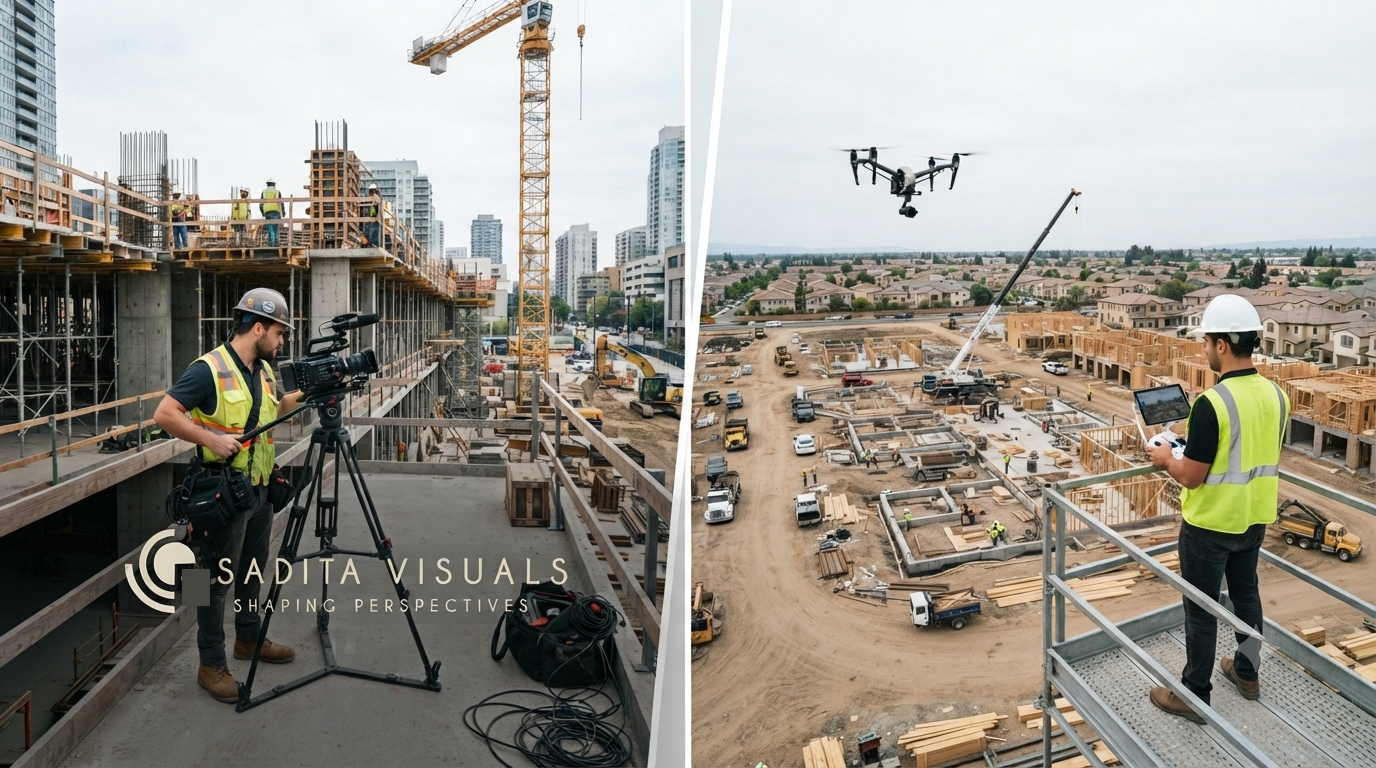
Why do we document in three phases? At Sadita Visuals, we don’t think of a project as a single photograph taken on the last day. We think of it as a story with a beginning, a middle, and an end, and we document it that way, across photography, aerial drone work, and ground-level video.
Phase 1: Origin (site, context, vision) Before anything is built, the site already has a story. Aerial imagery shows how a plot sits within its surroundings, its neighbours, its topography, and its light. This is the evidence that explains why the design looks the way it does. It’s also the one phase you can’t revisit once the cranes arrive.
Phase 2: Transformation (construction, craftsmanship, materials, team) This is the phase most often missed. Aerial progress captures show sequencing and scale in a way no ground view can. Ground-level video and still photography capture the people, the fabrication, the joinery, and the moment a material goes from delivery to detail. For contractors, subcontractors, and engineers, this is where capability is demonstrated. It’s also the material that makes a far stronger award entry or case study than a gallery of finished interiors.
Phase 3: Experience (occupation, lifestyle, human interaction, final imagery) Then the building is finished and used. Here we photograph and film the architecture as it was intended: lived in, moved through, and occupied. Still images remain essential. Short films often do more in a proposal or on a website because they show how a space feels, which a single frame can only suggest.
Be clear about the needs before asking for a shot list.
When several firms share a project, the usual instinct is to ask everyone what images they want. You end up with five wish lists that overlap, contradict each other, and assume access that may not exist.
A better first question is this:
What was important to communicate/document in this project that only those involved would have seen through doing it whilst onlookers could never know?
This shifts the discussion from "What do you want photographed or videos of, aerial and otherwise?” to "What made your work significant?” The answers are often surprising. A contractor explains why one detail took weeks to resolve. An engineer describes a constraint that reshaped the design. A consultant points to a decision that quietly improved how the building performs.
Some of that becomes a photograph. Some become a short film. Some become a single aerial flight at the right moment. And some is simply context that makes everything else better. But none of it can be planned for if nobody asks.
Gathering this input doesn’t mean everyone directs the shoot. Someone still has to set priorities, define scope, and own the final plan. Collecting information from many voices is very different from handing every voice equal authority.
The window is shorter than the shelf life.
Project imagery tends to be used for years: in proposals, award submissions (RIBA, FAD, and the EU Mies van der Rohe Award all expect strong visual evidence), presentations, tender documents, and websites. The people using it later may never have set foot on the site.
The opportunity to capture the project properly is much shorter. The construction phase ends. The scaffold comes down. The site context changes. And the thing your firm is proudest of may be behind plasterboard by the time anyone thinks to photograph it.
Most teams already understand this when it comes to formal progress reporting. The same thinking applies to storytelling. If the project is going to represent your firm for the next five years, it deserves a plan that covers more than the final day.
A note on the aerial work.
All drone operations we carry out are done under the EU framework (Regulation 2019/947), with A1/A3 and A2 certification, the STS-01 and STS-02 standard scenarios, and registration as an operator.
For architecture and construction clients, that means repeatable, compliant aerial documentation, which matters when a flight has to happen at a particular stage and can’t be rescheduled around the build.
Starting the conversation early
If you’re planning a project or already on site and you’re not sure what should be documented and when, that’s the conversation to have now rather than at handover.
Sadhita Visuals works with architecture studios and premium brands across Spain, Europe, and the UK, from our base in Valencia and Barcelona. We document the whole journey, from conception through construction to completion.
If something your team has done won’t be visible in the finished building, let’s talk about how to capture it while it still exists.
#ArchitecturalPhotography #ArchitectureVideo #AerialPhotography #AEC #ArchitectureMarketing #SpainArchitecture #ArquitecturaEspaña #Valencia #Barcelona